February 4, 2012

I’ve Moved!

The Walrus and the Carpenter have gone back to Wonderland, and I’ve moved to a new online home. You’ll find all the old posts there, but the blog’s name and appearance have changed.

You’re all invited to stop by. So, please come on over. Clicking on the house will take you there, and once you arrive, please sign up to follow me, and bookmark the new site in your favorites.

I’ll see you there!


January 27, 2012

Little Free Libraries! What a Great Idea.


Oh, friends, I have the most wonderful idea to share with you this week—Little Free Libraries. Have you heard of them?

These are small, wooden mini-libraries, little “houses” that can be mounted on a fencepost anywhere! Take a book, leave a book. The possibilities are endless.

The idea of Little Free Libraries began with Wisconsinite Todd Bol. He teamed up with his friend, Rick Brooks, to form the non-profit group Little Free Libraries.

The concept is simple. You make or buy a Little Free Library and install it near your house or business. Stock it with books to share, and spread the word. Neighbors and friends are welcome to take a book and either return it or replace it with a different book. What a great way to promote reading and especially to provide books for the neighborhood kids.

Take a look at this video, and read more about it here.


Little Free Libraries are popping up everywhere, and you can have one, too. The Little Free Library web page has plans for building and links to where you can buy one. Be aware, though, that buying one can be pricey.

Are there any carpenters out there willing to barter with me? I’ll do some writing/editing work for you if you’ll build a Little Free Library for me. Can you tell that I REALLY want one?!


This week's question: If you had a Little Free Library, what would you do with it and which books would you put inside?


BONUS--FREE PODCAST:
Listen to a free Podcast interview with Rick Brooks and Todd Bol on Wisconsin Public Radio's "Here on Earth" show. The show host, Jean Feraca is one of my favorites. Check out her other show topics in the "Here on Earth" archives.

And don't forget to "like" Little Free Library on Facebook.


January 22, 2012

5 Ways To Polish Your Word Weaving Skills

One challenge writers face is knowing exactly what a word means and then using it in a unique way. Great authors are more than writers. They weave words in one-of-a-kind patterns that create specific images in their readers’ minds. Often these writers throw out the mechanical rules of writing and allow the words to lead them.

The Merriam-Webster web page offers several ways to help writers increase their word weaving skills. Give them a try. Click on each link below.

1. Most Popular Words
Each day, Merriam-Webster posts lists of the 25 most frequently looked up words from the past 24 hours, past week, or past 4 months. Words frequently appearing on these lists provide a good idea of topics that are currently on peoples’ minds. Each word links to its definition.

2. Trend Watch
Words spike in popularity based on current events. Trend Watch is where you can see which words are trending and find out why. Entries often include interesting information about word origins.

3. Top Ten Lists
This section of the web page is a word weaver’s playground. It holds 50+ word lists on a variety of topics: Top 10 Charming Words for Nasty People, Top Ten Words for Useful and Intriguing Concepts, Words for Things You Didn’t Know Have Names . . . Did you know that your “philtrum” is that little dimple between your nose and your upper lip?

4. Vocabulary-Building Quizzes
The Merriam-Webster editors occasionally post vocabulary quizzes. These short, timed tests can help wake up your brain before you begin to write. Try these:

How strong is your vocabulary?

Name that thing.


5. Videos
This is the place where the Merriam-Webster editors speak directly to viewers about confusing grammar issues, word origins, and more. Take a look at this short sample, then post a comment telling us how you feel about using flat adverbs in your writing?


Ann Voskamp is one popular author who uses flat adverbs well.
Click here to visit her blog.


If you have some free time, try playing while you increase your word weaving skills. The Merriam-Webster web site also includes a nice selection of online word games.


January 12, 2012

Are You A Quirky Writer?

Stephen King writes just ten pages a day, every day, always in the morning. Maya Angelou prefers writing in hotels instead of at home, and she asks the hotel staff to remove everything from the walls of her room. Thomas Wolfe used the top of his refrigerator as a writing desk (he was a very tall man). And Edgar Allan Poe enjoyed writing with his cat, Cleopatra, on his shoulder.

Most writers are a bit eccentric. We have our quirks. So, I’ll share some of mine with you, if you’ll share some of yours with me.

The Top Ten Reasons Why I'm A Quirky Writer
:

1. I don’t like paper. Paper becomes clutter, and clutter distracts me.

2. I hate writing anything by hand. I procrastinate like crazy whenever I have to use penmanship.

3. When it's nice outside, I prefer to write in my car in a parking lot at the beach.

4. Writing doesn't feel right without a cat sleeping nearby. (I have two. Neither sleeps on my shoulder.)

5. Some of my best inspiration for dialogue and character development comes from reality shows. (The Duggers and Roloffs for happy family inspiration, The Real Housewives of [fill in the city] for utter chaos and dysfunction.)

6. Classical music helps me to concentrate when I write educational nonfiction. It transports me back to my days at the university and academia.

7. I prefer a laptop computer to a desktop. For me a laptop equals freedom. I don’t like being tethered to a desk.

8. I need to write in isolation and complete quiet. Even little noises bother me. I prefer to write late at night while the world sleeps.

9. Coffee. Coffee is very important when I write, but not just any old coffee. I fill a 16- ounce travel mug with a flavored latte that I make myself, or if it's summer I make a flavored iced latte. I sip on that for hours.

10. I have unusual objects in my writing space. There’s a six-foot artificial alpine tree with white lights in my home office and a jackalope head on the wall. (I rescued him from a thrift shop, and I like to dress him up for holidays). Near my desk, I have a wonderful, ugly-face, kitchen match holder that belonged to my grandma (I store large paperclips in it, which I never use because I hate paper.)

So there you have it. I’ve shared some of my silly writing quirks with you.

What are some of yours?


January 8, 2012

Writers—Six Ways to Beat Discouragement

Did you enter 2012 feeling discouraged about your writing? Maybe one of your goals for last year was to get your work published and that didn’t happen. You might be weary of the business side of writing, watching sales figures drop, working hard to promote your work and receiving little in return. Whatever the source of your discouragement, here are six surefire ways to beat it.

1. Fine-tune your workspace. Clean off your desk, rearrange the furniture, and change your screensaver to something bright and cheerful. Treat your space to some new, whimsical writing tools. Let in the light. Soak your space with sunshine.

2. Expand your horizons. Put your WIP aside and write in an unfamiliar genre. It doesn’t have to be epic or perfect. Just write. Try a poem, a play, or write an article about beating discouragement! An hour or two of unfamiliar territory might even inspire fresh, new ideas for your WIP or set you in an altogether new writing direction.

3. Tell it to your journal. Get all your discouragement down on paper. Let out the frustration, anger, and tears. Journal a letter to the agents and editors who turned you down last year. Tell them how you really feel. Sometimes just letting the discouragement flood out helps to get rid of it.

4. Ask the “you-too?” question. Network with other writers, either in person or on Facebook or other social media venues. Ask them if they get discouraged and what they do to beat it. You might be surprised to find that you have lots of company. Even multi-published writers get discouraged.

5. Use words to chase discouragement away. Choose and meditate on one positive, uplifting word like faith, hope, courage, or success. Read and think about quotations or scripture verses that relate to your word. Let them sink deep into your soul.

6. Focus on the gift. Concentrate more on the talent you have been given to write instead of your purpose for writing. I believe, and maybe you do too, that each of us is endowed with special skills. The reason for that endowment isn’t always clear. Maybe the purpose of your gift is to publish, or maybe it is to write blog posts that inspire. Perhaps your purpose is to write something that touches just one person in a way that changes his or her life. When you put the gift of writing above your perceived writing purpose you may find encouragement in unexpected places.

Vincent Van Gogh once said, “In spite of everything I shall rise again: I will take up my pencil, which I have forsaken in my great discouragement, and I will go on with my drawing.”

So, dump your discouragement. Take up your pencil and write!


December 26, 2011

Writers, Are You Ready for 2012?

I'm not the sort of writer who creates a list of writing goals at the beginning of a new year. Instead, I'll move forward into 2012 eager to see what each day brings. As 2011 ends, these three quotations from famous authors sum up how I feel.


“New Year's Eve is like every other night; there is no pause in the march of the universe, no breathless moment of silence among created things that the passage of another twelve months may be noted; and yet no man has quite the same thoughts this evening that come with the coming of darkness on other nights”
Hamilton Wright Mabie (American writer, 1845-1916)


For last year's words belong to last year's language. And next year's words await another voice. And to make an end is to make a beginning.
T.S. Eliot (British/American poet, 1888-1965)


We will open the book. Its pages are blank. We are going to put words on them ourselves. The book is called Opportunity and its first chapter is New Year's Day.
Edith Lovejoy Pierce (English poet, 1904-1983)


What inspires you as you enter a word-filled new year? Do you find it helpful to set goals and make resolutions?


December 23, 2011

Ham Salad Sandwiches on Christmas Eve

This is a repost from Christmas 2009. Enjoy!


When I was growing up, and well into my adulthood, my mom always served ham salad sandwiches on Christmas Eve. It was a tradition and not one that I particularly liked. Whoever heard of a ham salad Christmas?


After my grandparents had all passed away and mom continued to serve the sandwiches, I finally asked her why. I never expected the special story that she shared with me on that Christmas Eve night.


Mom’s family had little money. They lived in an upper flat just a block away from the railroad tracks. Freight trains traveled that line connecting Chicago and Milwaukee, and the boxcars often carried stowaways. Bums, they were called back then. Hobos.


Around suppertime on one cold Christmas Eve, the doorbell rang at my mother’s house. My grandfather answered it and found a “hobo” standing on the front porch. The man was dirty and cold, and he asked if he could have some food. My grandmother had just made ham salad for their Christmas Eve supper. It was the best my mother’s family could afford, and Grandma made it special. She ground the ham with a hand-cranked meat grinder, added homemade mayonnaise, a little pickle relish and a good dash of pepper. She was just about to spread it on slices of homemade buttered bread when the doorbell rang. Not wanting anyone to go hungry on Christmas Eve, Grandma packed a brown paper sack with several ham salad sandwiches and gave it to Grandpa. Mother remembered that the man smiled broadly when Grandpa handed him the sack, and Grandpa tucked several one-dollar bills into the man’s pocket, too – money that my grandparents really couldn’t spare.


My mother never forgot that Christmas Eve. After she married and took charge of our family’s Christmas celebration, she served ham salad sandwiches as a simple reminder that we had food while others were hungry.


If you are reading this, you most likely have a computer, a warm house, and are anticipating a Christmas Eve supper filled with good things to eat. As you celebrate, don’t forget the ham salad sandwiches. Many people are poor or homeless this year. Will you spare some “ham salad” for them?


I wish all of my readers a peaceful Christmas filled with joy. I’ll see you back here the first week in January.


December 10, 2011

The Backstories of Several Christmas Classics

Christmas is for stories. Here is the backstory about several classic favorites.

A Christmas Carol, by Charles Dickens—A Self-Published Success
Next to the Bible’s true story of Christmas, Charles Dickens’ A Christmas Carol is probably the most well-known story of the holiday season. David Purdue gives us the backstory on his wonderful “Charles Dickens Page."

“Dickens began writing his "little carol" in October, 1843 finishing it by the end of November in time to be published for Christmas with illustrations by John Leech. Feuding with his publishers, Dickens financed the publishing of the book himself, ordering lavish binding, gilt edging, and hand-colored illustrations and then setting the price at 5 shillings so that everyone could afford it. This combination resulted in disappointingly low profits despite high sales. In the first few days of its release the book sold six thousand copies and its popularity continued to grow. The first and best of his Christmas Books, A Christmas Carol has become a Christmas tradition and easily Dickens' best known book.” (copyright © 1997-2011 David A. Perdue)
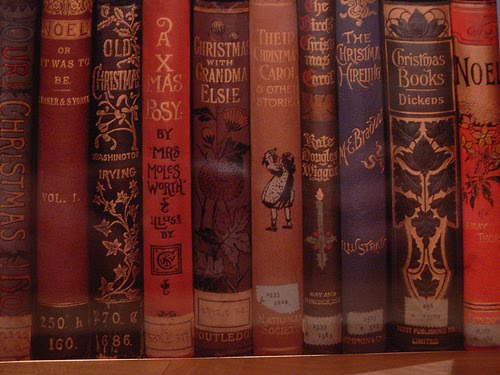
Dickens went on to write four additional Christmas stories: “The Chimes,” “The Cricket on the Hearth,” “The Battle of Life,” and “The Haunted Man.”


The Gift of the Magi, by O. Henry—Penned in a Tavern
O. Henry is the pen name used by American author, William Sydney Porter. According to The Literature Network, Porter spent several years in prison after being convicted of embezzling money. While in prison, he began writing short stories. His first, “Whistling Dick’s Christmas Stocking,” was published in 1899, while Porter was still incarcerated. After his release, he published more than 600 short stories using the name O. Henry. “The Gift of the Magi” was published in 1905.

In his later years, Porter suffered from alcoholism. The story goes that he penned “The Gift of the Magi” in his favorite booth in Pete’s Tavern. Surprisingly, Pete’s still exists. It claims to be the oldest continuously operating tavern in New York City.


The Night Before Christmas, by—Author Unknown
The authorship of “The Night Before Christmas,” also known as “A Visit from St. Nicholas,” is clouded in ambiguity. One story is that Clement C. Moore wrote the poem on a snowy day, in a sleigh, while returning home from a shopping trip. A friend of Moore’s liked the poem and sent it anonymously to the Troy, New York, Sentinel. They published it on December 23, 1823, and it became instantly popular. Moore, a Baptist minister and professor of theology, wasn’t sure that he wanted to take credit for writing the well-liked rhyme. He thought it might be too secular. But finally, in 1844 after the poem had garnered great success, Moore included it in a book of his poems and claimed it as his own. But the backstory doesn’t end here. In 2000, Donald Foster, a Vassar College English professor and authority on literary identity, disputed Moore’s authorship. He suggested that a farmer/poet named Henry Livingston Jr. wrote the famous poem. In fact, next week, Livingston’s descendants will release a new edition of “A Visit From St. Nicholas” with Livingston credited as its author. You can read more about it here on The Boston Globe’s web page.


So, there you have it, three backstories about three famous Christmas tales. After these stories became popular in the 19th Century, many more Christmas books were written. Some have become classics and others are not so well known.

Do you have a favorite Christmas story? Have you read a recent Christmas book that you believe will stand the test of time?


November 18, 2011

Guess Who’s Coming To My Thanksgiving Dinner

As you prepare for the Thanksgiving holiday, think about this: If you could invite five people to Thanksgiving dinner who have influenced you as a writer, who would they be and why would you choose them as your dinner guests?

Here’s my list:

1. God. I can’t picture what God might look like sitting at the dinner table. Can you? He is the One who most greatly influenced me as a writer. Through Him, I have landed some terrific writing assignments that made me dig deep into His Word and build faith, not only in Him, but also in my writing skills. God would sit at the head of my table so that I could honor Him and soak up whatever wise words He chose to share with me.

2. Mom. My mother read to me from the day I was born and instilled in me a great love for words. She often took me to the library to check out picture books, and then when I was older, we enjoyed reading and discussing chapter books together. Mom wrote poetry, and she encouraged me to write and offered valuable critique. I’m grateful that she lived long enough to see my first book in print. I’d love to have her at my Thanksgiving table so I could receive one of her big, warm hugs and hear her say again, “I’m so proud of you.”

3. David Grayson, also known as Ray Stannard Baker. His books are not well known, but I have fallen in love with his series of books about rural living in America. I enjoy his folksy writing style and his rich descriptions of life at the turn of the 20th Century. About Thanksgiving, Grayson said:

“Thanksgiving is the holiday of peace, the celebration of work and the simple life... a true folk-festival that speaks the poetry of the turn of the seasons, the beauty of seedtime and harvest, the ripe product of the year - and the deep, deep connection of all these things with God.”

I would welcome him at my dinner table to discuss his writing style and hear more of his adventures living the simple life.

4. Erma Bombeck. I want a little humor at my Thanksgiving table, and who better to provide it than Erma Bombeck? Erma and I share a dry sense of humor, and I’ve learned from her writing that humor, well placed and gentle, can lighten a topic that readers might otherwise find dull, dry or even disturbing. What fun it would be to watch her draw out God’s sense of humor. Can you imagine: “Hey God, don’t be shy asking for more. I came from a house where gravy was a beverage.”

5. Mrs. Hazelton. Jean Hazelton was my high school English teacher and the first teacher to notice that I had some writing talent. I felt embarrassed when she read to the class a humorous essay I wrote about an orchestra concert. Afterward, she told me that I should consider a career in journalism. I didn’t follow her advice, but now, years later, I wish that I had. It took me a while to realize that Mrs. Hazelton knew what she was talking about. I’d like to have her as my dinner guest so that I could thank her and she could say, “Jeannie, I told you so!”

So there you have it, my five favored guests. Now it’s your turn. Whom would you invite to Thanksgiving dinner?


November 9, 2011

Grip—An Avian Muse to Dickens and Poe

I was writing A Charles Dickens Devotional when I found some fascinating, lesser-known stories about Dickens’ the man. One of the most interesting involves his pet raven named Grip. There are several versions of the story. This is one of them--

Dickens loved birds. He had several as pets, but Grip was his favorite. Grip proved to be a bird of character, or maybe I should say a character of a bird. He mimicked the voices of the author and his children and pecked at just about anything he could find, especially carriage linings and the children's ankles. The big, coal-black bird stole things, like shiny coins and pieces of cheese, and buried them in the Dickens’ garden. Charles Dickens enjoyed Grip's antics so much, and he talked about them so often, that some of his friends called him “raven mad.” He even included Grip as a character in his novel Barnaby Rudge (1841):

‘What hast 
got in that basket, lazy hound?' 


'Grip, Grip, Grip--Grip the clever, Grip the wicked, Grip the 
knowing--Grip, Grip, Grip,' cried the raven, whom Barnaby had shut 
up on the approach of this stern personage. 'I'm a devil I'm a 
devil I'm a devil, Never say die Hurrah Bow wow wow, Polly put the 
kettle on we'll all have tea.' 


'Take the vermin out, scoundrel,' said the gentleman, 'and let me 
see him.'

Barnaby, thus condescendingly addressed, produced his bird, but not 
without much fear and trembling, and set him down upon the ground; 
which he had no sooner done than Grip drew fifty corks at least, 
and then began to dance; at the same time eyeing the gentleman with 
surprising insolence of manner, and screwing his head so much on 
one side that he appeared desirous of screwing it off upon the spot . . . 


'Bring him along,' said the gentleman, pointing to the house. But 
Grip, who had watched the action, anticipated his master, by 
hopping on before them;--constantly flapping his wings, and 
screaming 'cook!' meanwhile, as a hint perhaps that there was 
company coming, and a small collation would be acceptable.

When American author Edgar Allan Poe, who wrote at the same time as Dickens, read Barnaby Rudge, Grip became the inspiration for his famous poem, “The Raven.”

Once upon a midnight dreary, while I pondered, weak and weary,
Over many a quaint and curious volume of forgotten lore,
While I nodded, nearly napping, suddenly there came a tapping,
As of some one gently rapping, rapping at my chamber door.
"'Tis some visiter," I muttered, "tapping at my chamber door --
Only this, and nothing more."

Grip lived a long and healthy life with Charles Dickens until the bird became ill after ingesting some lead paint chips. Dickens took his feathered companion to a veterinarian who prescribed castor oil, but alas “quoth the raven” after living with the Dickens' family for 36 years, Grip succumbed and was “nevermore.”

In a letter to a friend, Dickens wrote a tongue-in-cheek eulogy to the bird, and then he had a taxidermist stuff its remains, preserve them with arsenic, and mount Grip in a shadow box. In 1971, a Poe collector donated Grip to the Philadelphia Free Library where he is displayed near the Rare Books Collection.


(For more wayside stories about well-known authors, check out:
Real life plot twists of famous authors.
)


If you enjoy reading Charles Dickens then you'll love my book, A Charles Dickens Devotional, written for Thomas Nelson Publishing, available mid-December. Click here for ordering information and to read a sample online.


November 6, 2011

Is That REALLY What You Meant To Say?

Spelling and grammatical errors might cause your readers to giggle when you don’t want them to. Here are a few examples.

It takes many ingredients to make Burger King great, but the secret ingredient is our people.

Try our sausages. None like them.

Coffee, 39 cents a lb. Stock up and Save. Limit: One. (Wow, .39 a pound!!)

The panda eats, shoots, and leaves.

Teen pregnancy drops off significantly after age 25.

“Yesterday, a woman bought eight jars of peanut butter on me,” said the clerk.

Adrienne read the note taped to the dollar bill changer. When using the washing machine, please remove all your clothes after the light goes out.

“The toilet is out of order,” he said, “You’ll have to use the floor below.”

“Let’s eat Mom!”

After rotting in the cellar for weeks, his brother brought up some oranges.

Her latest mystery has an ending that is a real cliff-dweller

She said, “It’s time to nip it in the butt.”

Remember, everyone makes misteaks.


Are you guilty of using dangling and misplaced modifiers, wrong words, and misplaced or missing punctuation? Has your mind tricked you while your fingers flew across the keyboard?


I was just kissing. (kidding)

Your story was awful. (awesome)

Tom and I enjoyed our curse. (cruise)

I apologize for any incontinence this has caused. (inconvenience)


Feel free to share your own funny examples in Comments, but please keep it clean. Children might be watching.


September 29, 2011

Writing Buddies, Unite!

In my friend Shari’s blog post, “When Inspiration Fades,” she writes about those times when writers feel like giving up. Like Shari, we all experience seasons of discouragement when our writing seems a little off. Characters we love become lifeless and boring. Plots fall flat. Words don’t flow as they should. Frustration sets in, and we ask ourselves, “Is all of this worth it?”

There’s a story in the Bible about Moses and the Israelites fighting a bunch of thugs called the Amalekites. Moses goes up a hill with the staff of God in his hands. As long as he holds the staff up, the Israelites win the battle. But when his arms get tired and he lowers the staff, the Amalekites wallop the Israelites. Moses’ friends Aaron and Hur see what’s going on, and they rush to his aid. They literally hold up Moses' hands until the Israelites conquer their enemies.

When we writers find ourselves in a battle of will, we need writing buddies to hold up our hands. Here are a few places to find them.


1. Writing Conferences. Whether you write for children or adults, there is a writers' group for you. The Society of Children’s Book Writers and Illustrators and American Christian Fiction Writers are just two of many groups who hold writers’ conferences all around the country. Attend conferences, and you’ll find plenty of Aarons and Hurs.

2. Facebook. If you choose your “friends” wisely, you can build a network of online writers who will be more than willing to hold up your hands. I’ve found some wonderful, supportive friends on Facebook. Many writers, published and unpublished, hang out there.

3. Local Writers’ Groups. Check with your public library about local writers’ groups. Most places have at least one where members can share and critique each other’s manuscripts and, of course, hold up each other’s hands.

In times of discouragement, remember these words from Vincent Van Gogh. “In spite of everything, I shall rise again: I will take up my pencil, which I have forsaken in my great discouragement, and I will go on with my drawing.”

How about you: Who holds up your hands?


September 20, 2011

More Than You Ever Wanted To Know About Me

I'm taking a short break from writing about writing to accept this challenge from my friend Susan Reinhardt, over at the Christian Writer/Reader Connection. Susan was inspired by her blog followers to share a little about her personal life. Susan, in turn, challenged her readers to do the same on their blogs. So here goes, my writer friends …

Here I Am From A to Z:

A. Age: Old enough to know now what I should have known 20 years ago.

B.
Baked Goods: I wish I could taste my Grandma Fischer’s cornbread again. Even the best writer would be challenged to describe it. Oh, the smell of that cornbread baking in her oven!


C. Chore you hate: Any kind of paperwork. I’m a paperless writer, and I like it that way. I hate paper!

D. Dogs: I love big Golden Labs, but cats suit my lifestyle better, except when they want to hang out on my computer keyboard.

E.
Essential start to your day: A morning prayer. Then coffee and writing.


F
. Favorite color: Shades of pale green.


G.
Gold or silver: I prefer the warmth of the color gold.


H.
Height: 5' 4." I wonder how tall I would look on the big screen. Have you ever seen an actor in person and said, “Whoa, he looks so much taller in the movies!”


I. Instruments you play: I played the flute in high school, and I was good at it. When I started college, I planned to be a band director. I played the clarinet semi-well and the piano not-so-well-at-all.

J. Job: Writer, writer, always a writer. Before I became self-employed, I worked as a writer/editor at Golden Books for almost 20 years.

K. Kids: Two cats and a ring-necked turtle dove.

L. Home: I’m a Midwest gal, and I must always be near water.

M.
Mother: Betty Fischer What an amazing woman of God she was. Mom taught me about faith through her example, and she prayed me through life. I miss her.


N.
Nickname: (Oh, dear)…. Jeanner Beanner.


O.
Overnight hospital stay: Last year I had surgery for uterine cancer. I’ve been cancer free for 15 months, and I praise God every day for my restored health.


P.
Pet peeve: When people are late.


Q.
Quote: "So don't be anxious about tomorrow. God will take care of your tomorrow too. Live one day at a time." Matthew 6:34


R.
Right or left: Well, that depends on the topic. Like The Scarecrow said in The Wizard of Oz, “You could go this way, but that way is very nice, too.”


S. Siblings: None, but I have fantastic surrogates.

T.
Time you wake up: I wake up when my alarm goes off and always with a protest. I’m not a morning person.


U.
University you attended: The University of Wisconsin in Milwaukee.


V.
Vegetable you dislike: Are cucumbers vegetables? Big dislike. I get hives.


W.
What makes you late: I’m never late. (See the letter “P”)


X. X-rays: The idea of all that radiation scares me.

Y.
Yummy food: My name is Jean and I am an ice-cream addict and a coffee snob.


Z.
Zoo animal favorite: Big cats. I have a thing for cats’ paws. There’s something so perfect and lovely about them.


Were you surprised by any of my answers? If you want to do this exercise, jump right in either on your blog or a short version in the comments.


September 5, 2011

How Many Rejection Letters are Too Many?

Last week on my Facebook page I posted a link to an article: “Kathryn Stockett’s ‘The Help’ Turned Down 60 Times Before Becoming a Best Seller.” The post generated a lively discussion.

The article said that Kathryn finished her first version of “The Help,” sent it out to an agent, and received a rejection letter. She kept revising her manuscript and sending it out. After the fifteenth rejection, a friend suggested to Kathryn that maybe she should begin writing her next book. But Kathryn refused. She believed in her story, and she wanted to get THAT book published before she wrote another. She pressed on through 60 rejections until an agent sold “The Help” to Amy Einhorn Books—and the rest is history.

On Facebook, my friends discussed whether it was wise for Kathryn to put all of her hope into one manuscript. What do you think? How many rejection letters are enough to herald moving on to something else?


Best-selling Books Repeatedly Rejected by Publishers

Auntie Mame, (rejected 15 times)
Jonathan Livingston Seagull (18)
Chicken Soup for the Soul (140)
Kon-Tiki (20)
Harry Potter (9)
Lorna Doone (18)
M*A*S*H* (21)
Carrie (30)
Gone With the Wind (38)
A Wrinkle in Time (26)

Read more about it.


August 28, 2011

Enthuse Your Muse With Strange and Unusual Places

Search online for places to inspire your next novel, and you’ll find scores of interesting venues just waiting for your characters to arrive and shake things up.


Here are several ideas to get you started.


Bithlo, Florida: Strange Sports
Head south to Bithlo for the “School Bus Figure 8 Races.” School buses, both traditional and custom designed, zoom around a figure-eight-shaped racecourse trying to navigate hairpin curves and avoid running into one another. What could be more fun than a place like Bithlo – the perfect setting for a quirky novel with quirky characters.

Cumberland Falls, Kentucky: Atmospheric Phenomenon
Moonbows occur regularly during the full moon at Cumberland Falls. A moonbow, or lunar rainbow, happens when moonlight refracts off the cascading water and creates a prism of light in the mist. Imagine that somewhere over the moonbow, a pair of lovers share a moonlit kiss in a romance novel written by you.

Ripon, Wisconsin: Historical Politics
Ripon considers itself the birthplace of the Republican Party. So does Jackson, Michigan. Dig a little deeper in Ripon, and you’ll find a granite marker near a small mid-1800s-style schoolhouse: “In this school house on March 20, 1854 was held the first mass meeting in this country that definitely and positively cut loose from old parties and advocated a new party under the name Republican.” What happened in that little schoolhouse when several dozen Riponians met to protest the extension of slavery? Is this sleepy, little town really the birthplace of the GOP? Here lies the plot for an historical novel about the evolution of the United States’ political system.

Darwin Falls, Minnesota: Unusual Landmarks
The world’s largest twine ball, rolled by one man, is displayed proudly in the town’s gazebo in Darwin Falls. Francis Johnson began rolling this ball of twine in his basement in 1950. He rolled four hours a day, every day, making sure that the ball was perfectly round. When it became too large for the basement, Johnson moved it to an open-air, circular shed on his farm. He kept rolling until he died in 1979. By then, the giant twine orb weighed nine tons and measured twelve-feet wide. My muse says 1950s Darwin Falls is the setting for a pre-teen novel about crop circles and a mysterious ball of string.

Annapolis Junction, Maryland: Secret Codes
The clandestine world of cryptology is unveiled at the National Cryptology Museum in Annapolis Junction. Are you thinking of an action-adventure novel full of mystery and intrigue? Then send your characters here to explore the code-making and code-breaking places, tools and techniques used by great masterminds of America’s national defense. Be careful, though. What your characters discover here might be a matter of life or death.

See? Just one unusual place is enough to inspire the setting, plot or characters for your next book.

Leave a comment, and share your ideas for other "novel" places.


August 21, 2011

Writing Tip: How to use Indirect Characterization

How well do you know your characters?

Good fiction digs deep into characters’ personalities. When writers go beyond direct narrative to show readers the depth of their characters, it is called indirect characterization. Indirect characterization is a subtle way of showing readers something about a character instead of telling them.

Here are the ways that indirect characterization works:

1. The setting, especially the contents of a character’s personal space (home, office, car, etc.), offers clues about the character’s personality.

When Linda Atkinson opened the front door, an overwhelming stench rushed past her; animal feces, rotting food, the unmistakable scent of mildew and mold. Slowly, carefully, she edged sideways through the narrow path in her aunt’s living room. Boxes packed with who-knows-what, stacked floor to ceiling, thrown precariously atop one another, blocked any light that might have come through the windows. Linda hesitated, fighting a crushing urge to run from the house and not look back.


2. Characters speak about one another giving personality hints to the reader.

“John always was one to procrastinate,” said old Mr. Potter. “He’s a selfish one, if you ask me. Too full of himself.”


3. Characters are what they do, say, and think.

Edward reached down and scratched Toby’s ears. The dog shoved its nose into the palm of Edward’s hand and licked it, wanting more. “You love me, don’t you boy?” said Edward. “You’re the only one who does.”


I wonder, thought Carolyn, if Ashley is really happy. She seems so on the outside, but there’s something about her that’s cynical and cold.


4. Characters are what they are compared to other characters.

Whenever Trevor swung the bat, at best it was a foul ball, but Wilson Mays, he connected almost one-hundred percent of the time.


The next time you read fiction, look for indirect characterization. Then practice using it in your writing.


August 12, 2011

Dreaming of a Writer's Retreat


My friend bought this as a gift to herself for her sixtieth birthday. It’s a fully restored 1946 Rascal travel trailer. She plans to join a group of vintage-trailer groupies who travel caravan-style to some of America's best campgrounds.

When I saw the Rascal, I thought: WRITER’S RETREAT! How cool would it be to haul this 12-foot writing hut to, say, Walden Pond (as it existed in Thoreau’s time, of course; writers don't need 21st Century tourists hanging around). I could sit in the Rascal, soak up the peaceful surroundings, and write to my heart’s content.


I fall asleep, almost every night, imagining the perfect place to write. I've always dreamed of having my very own writer’s retreat somewhere in a secluded woods overlooking a quiet, inland lake. No people. No sounds other than the gentle breeze rustling through the trees, tiny waves lapping the shore, birds singing, maybe an occasional grunt or howl from a wild animal, just to keep things interesting.

The other day, I got serious about turning my dream into reality. I Googled “writer’s retreats,” and I saw these. The web page said that I could order one and have it built in my garden (that is, if my garden were big enough for a retreat).

Here's the description for this one:

This wonderful garden retreat draws inspiration from the modest summerhouse in George Bernard Shaw's garden. This tiny, converted shed was where he created many of his masterpieces, including the Oscar winning screenplay for "Pygmalion" and the play "St Joan", for which he was to win the Nobel Prize for literature.


And this one:


The refurbished tool shed at the bottom of Virginia Woolf's garden forms the inspiration for the Reading Room. Despite living in privileged surroundings it was this distinctive outbuilding that was to provide her with the ideal place in which to write, think and relax.


If George Bernard Shaw and Virginia Woolf could have their own little retreats, then why can't I? (That's a rhetorical question if you're thinking of leaving a comment.)

I needed to know more. The web site offered an online brochure, so I clicked on its link (you can, too, by clicking here). I discovered that the manufacturer is in the UK, and the prices were listed only in pounds. I liked that. I don’t do “pounds.” Unless you consider my weight, I’m sure that I don't have enough pounds to splurge on one of these retreats, let alone have it shipped across the ocean and built in my backyard. So, I left that web site and decided to keep hanging onto my dream. Who knows? Maybe when my friend isn't caravanning around the country, she'll let me write in her Rascal.


What do you dream about
when you hear the words “writer’s retreat?”


Click here to see how this woman turned her Airstream trailer into a studio.